The Future of Satellites and Science: Three reasons why so much is at stake in the 2024 US election
By Carl Pope.
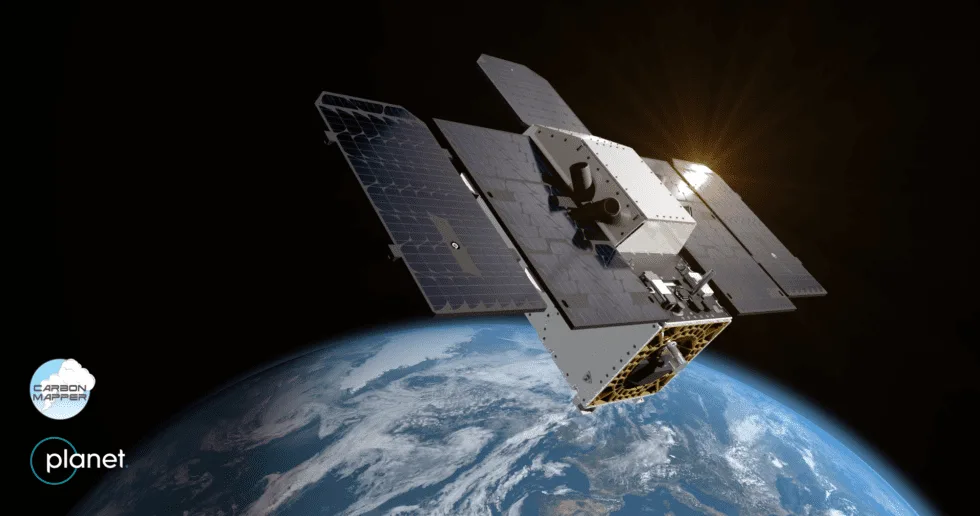
A rendering of a satellite set for launch in 2024, from the Carbon Mapper Coalition, that is set to expand emissions observations from space. (Photo from Carbon Mapper)
In the coming years, three of the major NASA satellites collecting weather and climate data will be powered down, according to an alarming report by The New York Times earlier this month. No other tools exist to inform our climate monitoring, forecast weather, or hold firms accountable.
Consistent and comparable scientific data drives informed decision-making for governments, companies, and people. Currently Mars science is already prioritized over Earth science with $2.2 billion of NASA’s $24 billion agency budget focused upon our weather and climate. And if Trump wins, Earth-focused satellites are even more likely to go unreplaced. What will happen, according to the Heritage Foundation’s ‘Project 2025 Playbook,’ is a series of policies that take deliberate aim at the federal investments in climate science. Here’s what else we will lose:
1. We will stop tracking data on heatwaves, wildfires, fog, and more. Satellites orbiting the Earth currently provide year over year data on the heat island effect, spot wildfires, and tell us about fog coming off the ocean. Project 2025 seeks to break up and downsize the National Oceanic and Atmospheric Association (NOAA) because “its current organization corrupts its useful functions.”
NOAA will then discontinue the deployment of its sophisticated equipment that measures urban heat, which is currently peer-reviewed and utilized by scientists globally. The information on surface temperatures and related trendlines over time are a valued input for many economic sectors, such as agriculture, tourism, and transportation.
In addition to the heat island effect, the disbanding of NOAA for its “preponderance of climate-change research” would have further implications on land and oceanic conditions, wildfire locations, and the ozone layer changes.
2. Weather forecasts could be manipulated to favor the few. In the Victorian times, British Vice Admiral Robert FitzRoy first introduced the concept of publicly available forecasts right before being bitterly attacked by business interests. Owners of fishing fleets opposed the provision of unbiased predictions because they knew their fishermen were unwilling to go out if there was bad weather. Profit and people’s well-being are not always aligned when it comes to weather.
Remember “SharpieGate”? It was the infamous relocation of Hurricane Dorian as heading for Alabama, not Florida, using a Presidential Sharpie to change its path. Trump didn’t even have a financial motivation for distorting that forecast.
Now again in 2025, a Trump Administration outlines plans to commercialize the National Weather Service. Privatized weather runs the risk of manipulated forecasts for business interests – a scenario which adversely impacts low-income communities.
We should shudder to think what kinds of weather misreporting he would indulge in with his new, privatized Trump Weather Service – or what it does for public trust to lose access to accurate, unbiased weather if information asymmetries are exploited.
3. Methane will leak, and we will turn a blind eye to violators. Almost half of the overheating that we expect in the next decade will come from methane – not carbon dioxide. Methane is odorless, colorless, and easily goes undetected.
Methane from oil and gas wells get two bites at the climate apple. First, we extract methane from wells to burn in furnaces, power plants, and industrial processes. Second, methane tends to leak out during fossil fuel production. It usually takes twenty years after methane is released for its concentrated warming to do the most damage. Methane observation satellites offer our only near-term hope of detection and accountability.
Yet Project 2025 suggests more methane leaks and less methane accountability. The Trump playbook outlines abolishing protections for land and water and rescinding the Biden era drilling and mining moratoriums. Further, the restoration of Trump-era “energy dominance” means opening the market up to oil and gas lease sales on- and offshore, slashing the royalties that fossil fuel companies pay to drill on federal lands, expediting oil and gas permitting, and rescinding Biden-era rules to limit methane pollution.
A lot of work remains to be done for scientific progress in Earth science even in a business-as-usual path. A Trump Presidency would mean backtracking on so much. While no single satellite will solve the climate crisis, a government that values monitoring science-based data, making information publicly available, and investing in the best tools is definitely the most promising path.